
St. Joseph, Our Patron
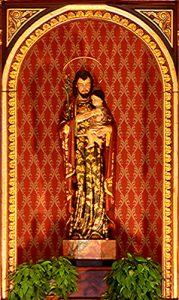 Saint Joseph, the Patriarch, is the chaste spouse of the Blessed Virgin Mary; the foster Father of our Lord Jesus; the Patron of Workers, being the village carpenter but of the royal line of King David; the Patron of Vatican Council II by Pope John XXIII; and the Patron Saint for a happy death, who died in the arms of Jesus and Mary, the Mother of God.
St. Joseph has been the city’s patron since 1610 [according to the Catholic Directory of the Philippines]. Devotees recall the many miracles he has bestowed the city through his powerful intercession.
According to legend, an old, half-blind gravedigger was digging the ground at a burial site, the same spot where the St. Joseph Cathedral now stands, when he saw a bearded old man tinkering with his tools. The old man didn’t say a thing but just smiled at the gravedigger. The gravedigger dismissed it as a product of his defective eyesight or a figment of his imagination.
But the old man appeared to him for the second time and he told everyone what he saw. People flocked to the site to see the ‘apparition’ but nothing happened. Some even stayed until darkness fell, waiting for hours to see the old man appear. Toward midnight, they saw on a pavement leading to the top of the knoll an image of an old man, then it disappeared, leaving only the sound of his tools, clink-clank of chisel and the echoes of hammer, saws and spades.
Most of the faithful believed it was the shadow of St. Joseph who appeared to them and the sound of his carpenter tools were regarded as a sign of his wish that a church be built on the spot where he appeared.
And so in 1776, they started building the foundation of a church on the spot where St. Joseph appeared, under a newly formed locality called Sarapsap (now Alaminos City).
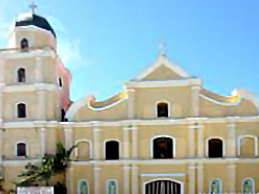
The first town church in Alaminos [known then as Sarapsap] was built in 1770 but was unfortunately burned together with the convent and municipal hall by the fire that razed the town in 1817. Six years later, the Augustinian Recollects formally established a parish, with Fr. Toribio Raymundo as the first parish priest and a resident pastor for 37 years [1778-1815].
1834. The church was burned again together with other buildings. It was painstakingly reconstructed under the term of Fr. Manuel Busqueto from 1837 to 1849. He invited Maestro Cenon, the same architect-engineer who made the classic church of Aguilar. Fr. Busqueto mobilized the entire town to contribute in rebuilding the church. He served for 16 years but died without seeing his masterpiece get finished.
Fr. Jose Tornos [1849-1878] continued the construction work for the new church and in 1857, it rose with stone walls, nipa roofing, a tabernacle and a niche for the church’s patron, St. Joseph. In 1872, the town’s name was changed into ‘Alaminos’ in honor of the country’s Governor-General, who visited the town that year.
In 1879, Fr. Victoriano Vereciano came to serve as parish priest and became the most popular Spanish priest in town, beloved by the people. In 14 years, he made many improvements in the church and convent. With solicited funds, he bought the best available hard wood: agaro from the forests of Zaragoza and tindalo from Alos; the church’s nipa roofs became galvanized iron sheets. Other improvements included wood parquet for floors of the loft, new coat of paint for the ceiling, iron grills for communion and a lovely choir loft at the back of the chair.Also added were a silver altar, a huge sanctuary light, cemented floors, and heavy large bells. Parishioners helped complete the project by preparing meals for the construction workers.
Fr. Vereciano died in 1893 and was succeeded by Fr, Andres Romero who enlarged the cemetery and reconstructed the chapel. He was captured and executed during the Philippine revolution.
By 1901, the Augustinian Recollects had left the parish’s administration to the local clergy. Fr. Toribio Macazo, a Diocesan priest established the Institute of San Jose [affiliated with the Lyceum of the Philippines], the first of its kind in the province of Pangasinan.
From 1926 onwards, various improvements were undertaken for the church by the priests that were assigned to serve the parish. Among the improvements include: statue of the Sacred Heart of Jesus [1930], grotto of Our Lady of Lourdes which was sculpted by the late Filipino artist and clergyman, Archbishop Mariano A. Madriaga,construction of new church pews, concreting of church belfry, fences for the church’s frontyard, installation of a new tabernacle, Our Lady of Carmel chapel and mortuary and the installation of large Stations of the Cross, done by a local artist.
June 28, 1985. Alaminos became a Diocese and the church became St. Joseph Cathedral, with the town’s first bishop, Jesus Cabrera overseeing more improvements such as the marble altar and floors, new sacristy, the rise of Alaminos Pastoral Center,Perpetual Adoration Chapel and repainting of the whole church [1995].
At present, the cathedral stands on the spot chosen by the town’s pioneers more than 200 years ago, ever welcoming of parishioners, a survivor of fire, raids,and natural disasters. It remains a beacon of hope, a reminder and a lasting testament of the enduring strength and unshakeable faith of Alaminians.
- Faith Enshrined: Churches of Pangasinan by Visitacion R. dela Torre
- Hundred Islands, Hundred Reasons [Alaminos Magazine], 2007
- Compilation of Alaminos History [Alaminos City Library]